 Broadcasters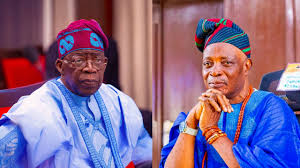
When history bends in irony, it often does so with drama, spectacle, and memory etched in sharp relief. The coronation of Senator Rashidi Adewolu Ladoja as the new Olubadan of Ibadanland is not just a royal ascension; it is the resurrection of unfinished stories, the unmasking of old betrayals, and the ultimate theatre of Nigerian politics where kings and politicians meet under one roof. But nothing embodies this irony more than the likely presence of President Bola Ahmed Tinubu, himself a member of the infamous class of 2003 governors, and once an adversary in the chessboard of Yoruba politics.
To understand this coronation, one must rewind the reel of history to the 2003 elections. That year, Nigeria’s political landscape was reconfigured with ruthless precision. The PDP machine, powered by President Olusegun Obasanjo, swept through the South-West, unseating virtually every Alliance for Democracy (AD) governor. Bisi Akande of Osun was uprooted, Adebayo Adefarati of Ondo was sent packing, Lam Adesina of Oyo was shown the door, Niyi Adebayo of Ekiti was toppled, and Olusegun Osoba of Ogun was humiliated out of office.
The only man who survived the hurricane was Bola Ahmed Tinubu of Lagos—a survival he owes not merely to popularity, but to the dark arts of political calculation, strategic deals, and raw street power.
And in Oyo, it was Rashidi Ladoja who emerged as governor, riding on the PDP’s national wave. He belonged to that new governors’ class of 2003, a set that included Tinubu (Lagos), Ladoja (Oyo), Bukola Saraki (Kwara), Lucky Igbinedion (Edo), Adamu Mu’azu (Bauchi), Donald Duke (Cross River), Orji Uzor Kalu (Abia), Achike Udenwa (Imo), Peter Odili (Rivers), Ahmed Makarfi (Kaduna), Ibrahim Shekarau (Kano), and others. It was a class that would later redefine Nigerian politics, birthing senators, ministers, party barons, and even presidents.
Yet, in the South-West, this class was deeply divided. Tinubu, the lone AD survivor, became the regional generalissimo, quietly plotting a comeback for his party, while Ladoja, as governor of Oyo, became a pawn in the internecine wars of PDP godfathers—especially the infamous Lamidi Adedibu, the so-called Garrison Commander of Ibadan politics. Ladoja soon discovered that governorship in Oyo was less about policy and more about appeasing political godfathers. His refusal to be pocketed by Adedibu set off a chain of conflicts that culminated in his impeachment in January 2006, a sordid episode widely believed to have been engineered by forces both within and outside Oyo—including Lagos.
It was no secret then that Bola Tinubu, who had begun laying the foundations of his regional empire, saw Oyo politics as a crucial battleground. Ladoja’s fall and reinstatement by the courts symbolized the fragility of democratic institutions in the face of ruthless ambition. If Tinubu survived 2003 by mastering the game of deals, Ladoja nearly perished in 2006 for refusing to play by the same rules. The bitter irony is that today, while Tinubu sits in Aso Rock as Nigeria’s president, Ladoja ascends the ancient throne of the Olubadan, wearing a crown that is not subject to impeachment.
This coronation will not be an ordinary ceremony of beads, drums, and chants. It is a reunion of history’s survivors. The ghosts of 2003 will hover over Mapo Hall, whispering tales of betrayal, resilience, and irony. Imagine Tinubu—once the last man standing of the AD, now the ultimate emperor of Nigeria—looking across at Ladoja, once a casualty of political backstabbing, now enthroned as the undisputed king of Ibadanland. Their gazes will carry unspoken words: a reminder of how far both men have come, and how politics often consumes its own children before offering them new crowns.
The irony deepens when one recalls that in 2003, Ladoja’s victory was part of Obasanjo’s masterstroke to weaken Tinubu. The PDP had thought Lagos would fall, but Tinubu held on. Today, it is Tinubu who sits atop the Nigerian presidency, while Ladoja, who once had the trappings of gubernatorial power, finds refuge in the timeless legitimacy of Ibadan monarchy. Where politics failed him, tradition has vindicated him.
The class of 2003 remains pivotal in this analysis. Many of them have faded—Lucky Igbinedion is remembered for corruption scandals; Orji Uzor Kalu is a senator, bruised but unbowed; Donald Duke, once the golden boy of Cross River, is now a political afterthought; Bukola Saraki rose to Senate President before falling out with Tinubu’s APC machine. Among them, only Tinubu climbed to the presidency. But Ladoja too, in a different dimension, has outlived the chaos of party politics, re-emerging in dignity as monarch.
There is poetic justice here. The Olubadan stool, unlike political office, is not won by treachery or elections but by seniority and destiny. Ladoja’s path to the throne was long, steady, and immune to the intrigues that once hounded his political life. Tinubu, however, remains the same Machiavellian operator who clawed his way from governor to kingmaker to president. The contrast between the two men could not be sharper: one rose through patience, tradition, and destiny; the other through scheming, power, and relentless ambition.
At the coronation, the symbolism will be overwhelming. When Tinubu bows, as protocol demands, before the Olubadan, it will not just be an act of courtesy—it will be the bowing of politics before tradition, of fleeting power before enduring heritage. Nigerians watching closely will see beyond the smiles and handshakes. They will see the irony of history: Ladoja, once impeached and disgraced, now crowned; Tinubu, once cornered and nearly annihilated in 2003, now the nation’s president. Both survivors of a brutal era, both symbols of resilience, but molded by different philosophies of power.
And herein lies the sharpest bite: Tinubu’s presidency, already battered by accusations of economic mismanagement, hunger, and repression, contrasts bitterly with the dignity of Ladoja’s coronation. While Tinubu presides over what many Nigerians see as the darkest chapter since independence, Ladoja ascends as a symbol of cultural continuity and stability. The crowd in Ibadan will not just be celebrating a king; they will be celebrating survival, justice, and the triumph of tradition over transient political treachery.
The coronation of Rashidi Adewolu Ladoja is therefore not merely a local Ibadan affair. It is a historical drama, an ironic theatre where 2003 meets 2025, where kings and presidents cross paths, and where destiny delivers its verdict. For Bola Ahmed Tinubu, it will be a reminder that even the most ruthless political games cannot outshine the permanence of culture. For Ladoja, it will be the sweetest revenge: a rose in the midst of thorns, finally crowned.

 Our Reporter